Specialty Diver courses
Improving Diving Skills specialty
"It is always possible to improve" - is not just a slogan, but an attitude that pushes to improve and move forward.
Many divers, both beginners and experienced, neglect important practices and do not devote enough time to improving the skill.
RESCUE DIVER
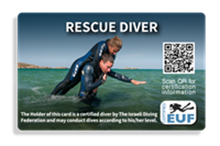
The Rescue Diver class is aimed at the diver who wants to acquire what are considered to be the most important skills in recreational diving. The Rescue Diver is a diver who is able to assist their fellow divers and is able to cope with emergency situations in diving, and beyond...
NITROX Diver ISO 11107
NITROX is used for increasing the safety of recreational diving and is a pre-requisite for technical diving and closed circuit diving classes.
The Israeli Dive Federation (TIDF) offers two levels of NITROX specialty classes, which may be undertaken separately or as one combined class.
BLS & Oxygen Administration
This specialty primarily trains divers at all levels to provide first aid in diving accidents and injuries occurring during diving activities. It also suits non-divers involved in dive-related activities, such as dive boat captains, lifeguards at stations near dive sites, dive club receptionists, authority inspectors, academy staff, and other workers offering direct or indirect services to diving participants.
Deep Diver (42 M)
Many dive destinations exist which are deeper than 30 meters. These sites are still within the range of recreational diving and are well-suited for experienced divers. Such divers, if they gain the necessary knowledge and experience for such dives, can expand the range and diversity of their diving exploits.
Underwater navigation specialty
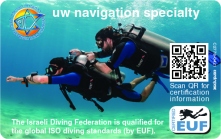
Underwater navigation skills, beyond enabling the diver to repeat a chosen dive route, also constitute a highly important safety tool. The ability to follow a planned route, conserve precious air, and adhere to the dive plan depends to a great extent on the diver’s capacity to navigate underwater.
In addition, this specialty serves as an introduction to developing the skills required to lead other divers. Needless to say, a group leader should be able to navigate and carry out a pre‑planned dive route.
Underwater search and recovery specialty
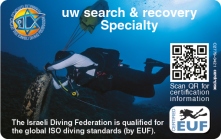
Objects are often dropped from boats and jetties, or people lose various items while swimming or snorkeling in the sea, and they frequently come to the dive club asking for assistance.
Not infrequently, the dive club is approached to carry out an interesting project that involves locating a specific object underwater, and sometimes even moving it or retrieving it from the water.
Dry Suit Diver specialty course
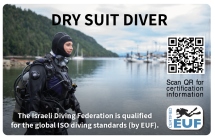
The diving suit has two main uses, protection from the marine environment and keeping the body warm. In cold water dives and/or particularly long dives, it is very important to maintain body temperature, both in terms of comfort and enjoyment of diving and in the physiological aspect - the drop in body temperature can lead to hypothermia and even accelerates the decompression phenomenon.
A dry suit is ideal for keeping the diver's body warm, but using DRY SUIT requires training
Recreational SideMount Diver
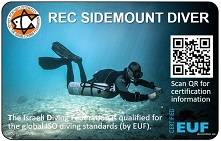
The SideMount configuration is one where the dive tanks are carried on the sides of the diver’s body. Its roots are in cave diving. Cave divers that had to navigate restrictions tried various tank-carrying configurations until hitting upon the structured configuration known today throughout the world as SideMount.
Boat diving specialty
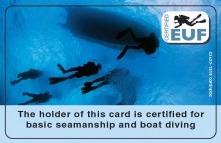
One of the key components in dive planning is the ability to integrate actual sea and dive conditions. This specialization will cover the use of vessels as a means to reach the dive site and return from it, the organization of the vessel and diving from it, and the integration of forecasting and addressing sea conditions as part of the overall dive planning and execution
Compressor Operator Specialty
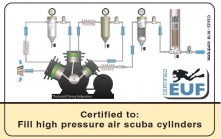
compressor operator specialty is intended primarily for the dive center staff. However, diving instructors, divemaster and divers, will find great interest in this specialty. In addition, because there is no need for a diving certification as a prerequisite for this course, this is a practical way to connect non-divers to get involved in the dive center.
During the course, the students will learn about the structure and operation of high-pressure compressors, acquire a great deal of knowledge about SCUBA cylinders, and of course will experience air filling of scuba cylinders.